

How To Draw Perspective For Comics
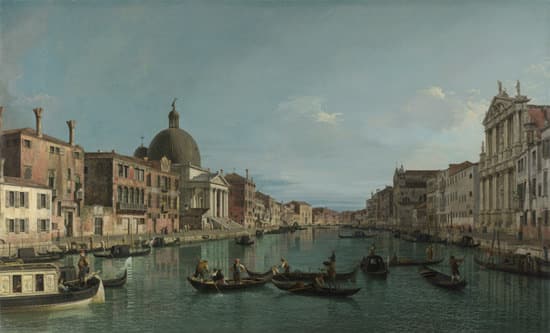
Caneletto, Venice, The Grand Canal, about 1740
Perspective techniques for absolute beginners
How to solve a problem like perspective?
Perspective is ane of the almost mutual bug beginners accept with drawing and painting.
Go it wrong and it tin easily ruin a bang-up start, get it right and it tin instantly meliorate your piece of work.
If y'all're like nearly painters you lot are probably trying to create a sense of depth in your work.
Leading the viewer's eye deep into the scene giving the illusion of reality.
But sometimes it just doesn't look right.
The distant object doesn't look then distant, your figures look out of proportion, a building looks like it is sliding off the page. And your still life merely looks….odd.
Yous are not lonely….
Why is drawing perspective then hard?
This is i of the most mutual causes of frustration in learning to draw.
Yous tin can shade pretty well, you've got assuming, expressive marks but your row of copse simply don't recede into the groundwork as you would like.
Sometimes the biggest problem with perspective is the word 'perspective'.
It is also off-putting and brings up memories of vanishing points and technical pencils, but perspective doesn't take to be rulers and set squares just elementary techniques to add depth to your paintings.
In practical terms when sketching, yous don't need to know 'classical linear perspective' you simply need a few pointers.
Simple perspective principles
i. Overlap
This is the easiest mode to add perspective and hands overlooked.
All you lot need to practise is place one object in-front of the other.
Simple.
This helps your viewer to judge the relative size of an object.
In landscape painting, this tin especially be difficult to judge as a view could stretch back in the distance for miles but without the use of overlap, it can exist difficult to guess, only how far.
It doesn't always have to be as obvious as a tree in front of a fence, overlap can happen everywhere, especially in nature.
Simply overlapping branches on a tree will requite assist to give the illusion of depth. Now this isn't going to be Houdini standard illusion but in perspective, every little helps.
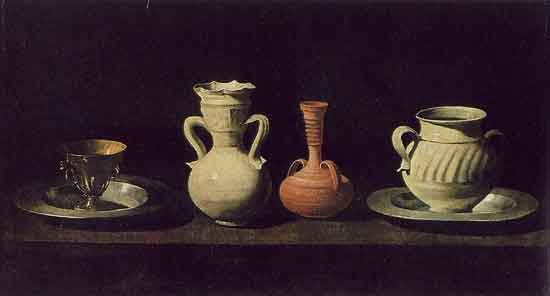
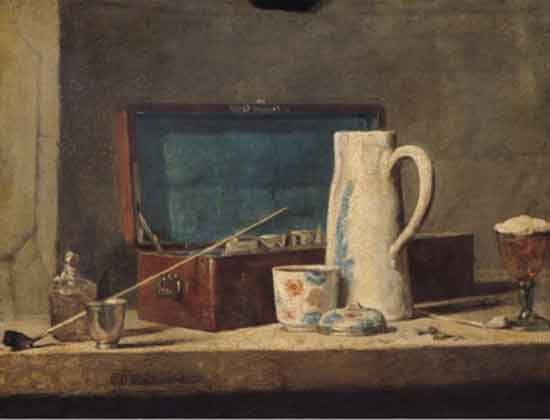
Pro tip: Length of shadow cast. If you have a jug in front of a box equally in Chardin's painting higher up, yous can tell the distance by the length of the cast shadow it creates. Although not obvious, information technology helps our subliminal mind to make sense of the scene before united states. Whereas in the showtime painting past Zurbaran, the perspective is very apartment making it harder to judge relative sizes.
This simple positioning of objects tin can make a bang-up deal of difference in creating the illusion of depth in your paintings.
Why?
Information technology is very difficult to approximate the sizes and distances of objects if they are placed side by side on a surface.
You lot have to try and give the viewers clues to understand the human relationship betwixt objects.
Action stride 1: Stride-by-step perspective notwithstanding life gear up-up
- Step ane –pick two objects for a still life, we want action here so allow us pick an apple tree and a cup.
- Step ii –place them side by side on a table and lower your gaze flat on and then you lot're horizontal with the table and the table peak disappears.
- Step 3 –clarify the view. which one looks farther away?…It's difficult to tell.
- Step 4 –move the apple tree to the left to overlap the cup.
- Footstep 5 –bank check the negative spaces yous have merely created. This is key in creating a balanced composition
- Step 6 –turn off all lights in the room autonomously from 1 single lamp, a torch will also work. This will create a potent cast shadow. Motion the apple closer to, or further away from the cup to kickoff to run across the effects of a bandage shadow when creating the illusion of depth.
- Step 7 –draw it!
But I can't draw! ….don't worry, permit'south expect first at the science behind drawing.
Left Brain / Right Encephalon
Every bit with virtually things drawing wise, in order to really 'run across' a field of study you take to acquire the power to trick your dominate left brain.
This is the logical, sensible side that likes to characterization things, guild things, and always tries to 'assist' your more than creative right side when your are drawing.
Past help, I actually hateful hinder. It means well only can quickly stop progression in drawing by being too clever for its own good.
Left brain thinking
If you lot know a chair has 4 legs only tin can but see 3 your logical brain tries to help you out and will urge y'all to draw in a fourth leg, even if y'all tin't run into it from the angle you are looking at.
It is very powerful.
If you want to test your left encephalon/ right brain for drawing take a expect at this experiment on the lateral thinking blog, information technology will mess with your heed!
How did you go on?
If you are naturally left brained, it volition be harder for your brain to make the jump to a more than spatially aware right encephalon, now I say harder, simply not impossible.
If yous draw what you lot see rather than what yous 'think you know' your drawings will exist more realistic.
"An individual'southward ability to draw is… the power to shift to a different-from-ordinary style of processing visual data – to shift from verbal, analytic processing to spatial, global processing."
Betty Edwards – author of drawing on the right side of the brain
Recall abstract to create realism
You need to endeavour and forget everything you lot think yous 'know' about a subject in order to really draw it as it appears.
If you are drawing a house in the distance, your left encephalon tells yous a house is large, and then even though yous run into it small, the tendency will still be to draw information technology slightly bigger.
Only slightly, you endeavour to kid yourself.
It won't make much of a departure.
However, all these slight alterations affect the overall sense of depth in a painting.
This can crusade your drawings or paintings to expect wrong or out of perspective very hands, in that location isn't a huge margin for fault.
Size and infinite
Tracing gets a bad rep, people think tracing is bad. Now I'one thousand not talking about tracing over things you lot desire to draw, far from it. I'grand talking about using tracing every bit a method to help yous learn to encounter.
To beginning with it is soooo helpful considering you can create unproblematic, in proportion views to work from. There is nothing like getting frustrated and stopping too soon.
And so to sympathise the benefits of tracing we demand to sympathize the picture plane.
What is the picture airplane?
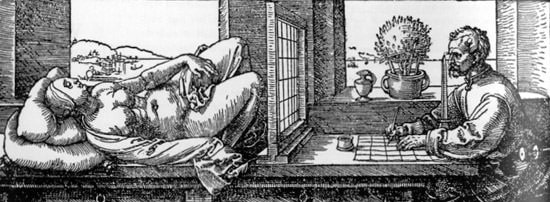
Albrecht Durer using an actual flick plane to assistance his drawing, 1525
When you are learning how to describe, everything has to be envisaged through a frame, as all paintings and drawings exist inside this.
If you lot imagine a slice of rectangular or foursquare clear glass to be prepare vertically between y'all and the things you lot are drawing or painting and imagine that you are actually seeing through the glass and simply tracing on information technology.
This is substantially all drawing is.
Cartoon realistically is "copying" what you run across on the picture airplane.
So, the pic plane 'exists' in the mind's eye, it is non a physical matter. It can be hard to get your head effectually it.
If your sitting at home, have a look through a window if y'all had a non-permanent marker yous could depict around objects on the 'picture plane' on the window. This is an amazingly useful thing to do. It will highlight some central reasons why your drawings are going wrong.
Movement
If you move your head from a constant position the cartoon on the window will non line upwards with the field of study, this is key. Remember the story near the iii legged chair? This is exactly what happens when you begin to pigment. Your left brain tells you lot to "motion round the corner," so you can run across the whole object rather than keeping in i position. Yous need to try and imagine your head is in a vice and can't motility from your chosen position!
If yous ever watch an artist drawing you will see that their eyes are constantly moving but their caput stays notwithstanding. Beginners often motion their head and go on their optics on the paper rather than on the subject.
And so let u.s.a. get back to perspective..
Action step ii: Tracing scale
Step 1 – Observe a picture that has a sense of depth, landscapes are perfect but you can spotter my example if y'all want to.
Step 2 – Lay a piece of tracing paper or clear plastic over the image
Step 3 – Draw over, just with line, the things that are repeated, and so in my example the buildings, this could be a row of trees or a row of telegraph poles. Ideally, an object that is similar in calibration and so not a business firm and a mouse!
This will be the biggest eye-opener. Objects become really modest, really quickly and as the distance from the viewer increases the spaces between objects gets progressively smaller.
Scale
In the secret of good composition, I talked almost the importance of variety in your work to help create a balanced composition and visual interest to your paintings.
When you are start get-go painting this unproblematic trick of irresolute the size and space variations tin aid immensely.
So each gap between a row of debate posts will be:
- A different scale
- A different shape
- Become smaller into the distance
- Go shorter into the distance
- Appear closer together into the distance
Nevertheless, even though we know this to exist true, when it comes to actually drawing this effect of changes in size, we are often more cautious than nosotros should be.
The bodily changes in scale can be HUGE simply it is hard for our logical side of our brain to realize this. We can measure them and 'prove' to ourselves they get smaller, but still, we tin can be hesitant when trying to draw something in perspective.
How to measure for scale
Have you ever seen an artist holding a pencil outstretched in front end of them and squinting their optics?
Wondered what they were doing?
Information technology was a simple measurement.
Our brain can easily play a trick on united states of america when learning how to draw in perspective so a quick measurement with a pencil is a great tip to easily bank check your cartoon.
You need measurements to notice:
- How far apart objects are
- Where the edges lie
- Relationships betwixt the size of an object
- Centre line of an object
The simplest thing to use is your pollex and a pencil.
The 3 primal points to recollect are:
i. Make sure to lock your arm, this will keep the pencil at the same distance from the object. It is easy to forget this and have a slight bend in your arm, this will give a different measurement and may mean you unnecessarily change your cartoon.
2. Try to keep your head notwithstanding and view the subject from i position. It is like taking a really long exposure photo where your eye is the camera lens and tin't motility its position.
3. Employ a long pencil, with a flat top edge. This will mean you lot have room for maneuver when measuring a diversity of objects.
How to measure subjects in a landscape with a pencil
- Lock your arm and hold it out in front of you so your arm is horizontal.
- You can apply anything with a straight border, pencil, ruler, knitting needle
- Close one eye
- Linen up the top of the subject yous are trying to measure with the top of the pencil (or another straight border)
- Move your pollex up the pencil to the bottom of the object yous are measuring.
This gives you your first measurement. You at present take to keep your thumb in this position so you can compare the length to another area of your drawing.
This can be on the vertical or horizontal, it is just to get a relative size.
Then if ane section is the same length y'all can bank check this against your ain drawing.
What matters is the proportion, non the bodily measurement.
If you lot have a pencil and a window, experiment with doing some relative measurements even without drawing anything. It is all-time to use objects that recede into the distance that are the same, and then a row of cars, the archetype debate posts etc, etc.
Another piece of cake tip to help you to see objects in isolation is just to roll up a sheet of A4 paper into a tube and use it equally a viewfinder. This way you can gauge its size in relation to the constraints of the tube rather than inside a scene.
When viewing a whole scene our encephalon accepts everything in front end of us, this is frequently why paintings have a flat or disjointed looking perspective.
Work within a frame
Have you ever started to depict in your sketchbook and run out of room? The model's feet somewhere off screen? It is because you weren't beingness specific nearly the edges of the image you were working within.
It is a useful trick to depict a frame edge within your sketchpad and so y'all accept a clear edge to work towards. This will help you lot with composition, positioning, and scale.
Relative heights
It doesn't matter if you lot can't measure the exact 'to the millimeter' size of an object all that matters in a drawing is the objects relative size to each other and then they look spatially right.
In traditional Atelier painting, a knitting needle and plumb line are oft used for measurement to create a traditional sight-size portrait.
The plumb line to enable you to judge your verticals equally well every bit to bank check alignments betwixt objects. For instance, the alignment betwixt the middle of an eye with the border of a mouth.
Drawing and painting realistically are all about checking and rechecking your cartoon. As you work longer on a subject y'all volition discover more than and more than subtleties. Also, as your center comes back fresh you lot will detect other areas that need irresolute.
Putting it all in perspective
Painting is always in a state of flux.
Beginners ofttimes get discouraged when they draw an object and say "Oh that's incorrect, I'g rubbish at drawing" whereas altering mistakes and fine-tuning details are all function of a drawing.
And let's not forget, these techniques are to create realistic paintings and drawings.
If you adopt a more than stylized or naive approach you could take a look at Cornish artist Alfred Wallis who had a unique arroyo to perspective.
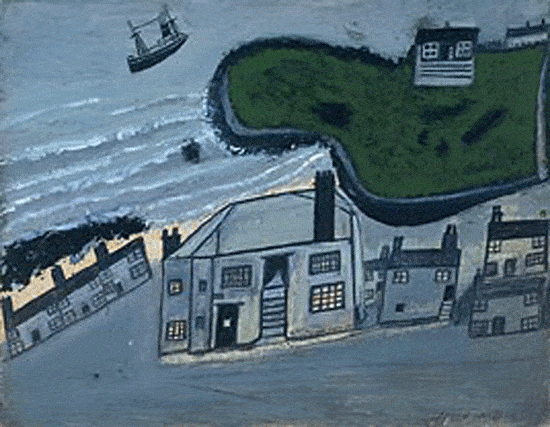
Alfred Wallis, The Agree House Port Mear Square Island Port Mear Beach, most 1932
He painted the objects at a relative size depending on the size he accounted the nearly important to him. If a gunkhole was the most of import thing, that was painted the largest. Ane point perspective wasn't needed as a more emotional response suited his needs. Don't get hung upwardly on getting everything perfect, just tweak a little at a time.
Another gimmicky example, is Henriette Simson who has just won the £25,000 Threadneedle Prize
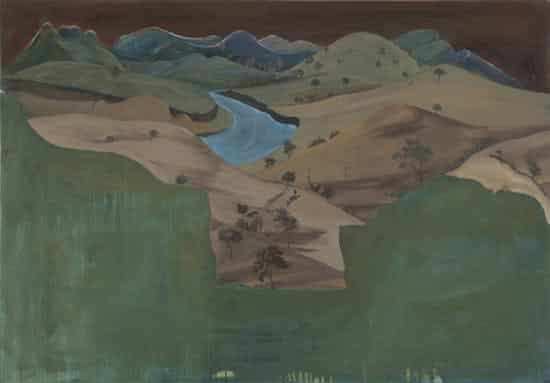
Henrietta Simpson, Bad authorities, After Lorenzetti
Her landscapes look at ideas around perspective, you can read a review on the winning piece at the Making a Mark web log
Resources:
one. Canaletto at the National Gallery, London
ii. Alfred Wallis at the Tate Gallery, St Ives

Source: https://willkempartschool.com/perspective-drawing-for-beginners/
Posted by: rountreeandestalmoss.blogspot.com
0 Response to "How To Draw Perspective For Comics"
Post a Comment