

What Conclusions About Industrialization And Progressivism Might One Draw From The Graph
Conclusion: Trends of the Gilded Age
The period between 1870 and 1900 in the United States is known every bit the "Aureate Historic period" and was characterized by economic and industrial growth, increased political participation, immigration, and social reform.
Learning Objectives
Summarize societal trends of the Aureate Age
Central Takeaways
Key Points
- The Gilded Age saw rapid economic and industrial growth, driven by technical advances in transportation and manufacturing, and causing an expansion of personal wealth, philanthropy, and immigration.
- Politics during this time non only experienced abuse, only too increased participation. The " political machine," in which constituents supported a candidate in commutation for anticipated patronage, reached new heights.
- The Gilded Age also was characterized by social reform, such equally women'due south suffrage, workplace improvements, prohibition, and civil service changes.
- Women were politically active and played a large role in the economy, both equally workers and consumers.
- Much social thought of the fourth dimension was characterized by explanations and justifications for the increasing wealth disparity among Americans, although there were many dissenting voices.
Key Terms
- The Gilded Historic period: An era in the U.s. from 1870 to 1900 characterized by industrial growth, political participation, and social reform.
- political machines: Political organizations in which an authoritative dominate or modest group commands the support of a corps of supporters and businesses (usually entrada workers), who receive rewards for their efforts.
- Susan B. Anthony: A leader in the women's suffrage motility and a key figure in the National American Adult female Suffrage Association.
- suffrage: The legal right to vote.
The Golden Age in U.Southward. history was an era in the late nineteenth century, from the 1870s to about 1900. The term for this period came into use in the 1920s and 1930s and was derived from writer Mark Twain's 1873 work, The Gilded Age: A Tale of Today, which satirized an era of serious social problems masked by a thin gilt gilding. The early on half of the Gilded Age roughly coincided with the middle portion of the Victorian era in Uk and the Belle Époque in French republic.
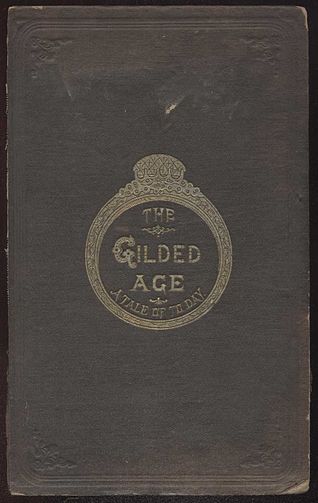
The Gilded Age: A Tale of Today. A book cover of The Golden Age by Marker Twain (1st edition, 1873).
The Golden Historic period was an era of rapid economic growth, especially in the North and Westward. As American wages were much higher than those in Europe, especially for skilled workers, the period saw an influx of millions of European immigrants. The rapid expansion of industrialization led to existent wage growth of sixty percent between 1860 and 1890, spread across the e'er-increasing labor strength. The average annual wage per industrial worker (including men, women, and children) rose from $380 in 1880 to $564 in 1890, a gain of 48 percent. However, the Gilded Historic period was too an era of abject poverty and inequality every bit millions of immigrants—many from impoverished European nations—poured into the U.s.a., and the high concentration of wealth became more than visible and contentious.
Railroads were the major industry, with the manufacturing, mining, and finance increasing in importance. Clearing from Europe and the eastern states led to the rapid growth of the Westward, based on farming, ranching, and mining. Labor unions became important in the very rapidly growing industrial cities. Ii major nationwide depressions—the Panic of 1873 and the Panic of 1893—interrupted growth and caused social and political upheavals. The South subsequently the Civil State of war remained economically devastated; its economy became increasingly tied to cotton wool and tobacco production, which suffered from low prices. With the finish of the Reconstruction era in 1877, black people in the South were stripped of political ability and voting rights and were left economically disadvantaged.
Politics
The political landscape was notable in that despite some corruption, turnout was very loftier and national elections saw two evenly matched parties. The ascendant issues were cultural (especially regarding prohibition, instruction, and ethnic or racial groups), and economic (tariffs and coin supply). With the rapid growth of cities, political machines increasingly took control of urban politics. Unions crusaded for the 8-60 minutes working solar day and the abolitionism of child labor; middle-class reformers demanded civil service reform, prohibition, and women's suffrage. Local governments across the North and West built public schools chiefly at the unproblematic level; public loftier schools started to emerge. The numerous religious denominations were growing in membership and wealth, with Catholics achieving the largest numbers. They all expanded their missionary activity to the globe arena. Catholics and Lutherans set parochial schools, and the larger denominations set up up numerous colleges, hospitals, and charities.
Women in the Gilded Age
During the Gilded Age, many new social movements took hold in the The states. Many women abolitionists who were disappointed that the Fifteenth Amendment did not extend voting rights to them, remained agile in politics, this fourth dimension focusing on bug important to them. Reviving the temperance movement from the 2d Not bad Awakening, many women joined the Women'due south Christian Temperance Spousal relationship (WCTU) in an attempt to bring morality back to America. Its primary leader was Frances Willard (1839–1898), who had a national and international outreach from her base in Evanston, Illinois. Often the WCTU women took up the issue of women's suffrage, which had lain dormant since the Seneca Falls Convention. With leaders such equally Susan B. Anthony, the National American Adult female Suffrage Association (NAWSA) was formed in lodge to secure the right of women to vote.
Many immature women worked as servants or in shops and factories until marriage, and so typically became total-time housewives. Nevertheless, blackness, Irish, and Swedish adult women oftentimes worked every bit servants. In most large Northern cities, the Irish Catholic women dominated the market for servants. Heavy manufacture was a male domain, but in light industries such as textiles and food processing, large numbers of young women were hired. Thousands of young unmarried Irish and French Canadian women worked in Northeastern cloth mills. For women coming from poor families, these jobs meant upwards social mobility, more money, and more social prestige that made them more than attractive marriage partners.
Social Thought
Scientific discipline likewise played an important office in social thought as the piece of work of Charles Darwin became popular. Following Darwin's idea of natural selection, English language philosopher Herbert Spencer proposed the idea of social Darwinism. This new concept justified the stratification of the wealthy and poor, and it was in this proposal that Spencer coined the term "survival of the fittest."
Joining Spencer was Yale University professor William Graham Sumner whose book What Social Classes Owe to Each Other (1884) argued that assistance to the poor actually weakens their ability to survive in guild. Sumner argued for a laissez-faire and free-market economic system. Few people, however, agreed with the social Darwinists, because they ridiculed religion and denounced philanthropy.
Henry George proposed a "single tax" in his book Progress and Poverty. The tax would exist leveled on the rich and poor alike, with the backlog money nerveless used to equalize wealth and level out society.
The Norwegian American economist Thorstein Veblen argued in The Theory of the Leisure Class (1899) that the, "conspicuous consumption and conspicuous leisure" of the wealthy had get the basis of social status in America.

Source: https://courses.lumenlearning.com/boundless-ushistory/chapter/conclusion-trends-of-the-gilded-age/
Posted by: rountreeandestalmoss.blogspot.com
0 Response to "What Conclusions About Industrialization And Progressivism Might One Draw From The Graph"
Post a Comment